Most creators do not miss trends because they are lazy. They miss trends because they look for them too late, in the wrong places, or with the wrong mindset. By the time a topic feels obvious, the highest-leverage discovery window may already be closing. In 2026, the advantage goes to creators who can spot trend signals early, validate them quickly, and adapt them to their niche before the topic becomes crowded.
This does not mean chasing every noisy hashtag or reshaping your brand every week. It means learning how to separate temporary spikes from durable curiosity, and cultural momentum from empty virality. TikTok’s 2026 trend forecast describes a shift toward curiosity, community, and what it calls emotional ROI. That is a useful signal: people are not just reacting to novelty, they are searching for relevance, usefulness, and connection.
The best trend research is not about copying what is already working for someone else. It is about noticing what your audience is beginning to care about, then getting there early with a format and perspective they trust from you. Here is how to do that systematically.
Why trend timing matters now
Trend timing matters more today because discovery is faster and more distributed. On YouTube, people move between Shorts, long-form, podcasts, live streams, and image posts. On TikTok, search behavior increasingly blends entertainment, product discovery, and niche community research. The result is that trends now leak across formats and platforms more quickly than before.
That creates a narrow but valuable window. If you arrive too early, the audience may not yet have the language for the topic. If you arrive too late, the market is crowded with summaries, reaction clips, and recycled takes. The goal is to enter when curiosity is real but saturation is still low.
The three places creators should watch first
First, watch audience behavior on the platforms where your content already works. Your own comments, DMs, and watch patterns often reveal trend demand before external reports do. A repeated question is usually a stronger signal than a viral post with no fit to your niche.
Second, monitor adjacent creators instead of just direct competitors. Sometimes the earliest useful topic signals come from neighboring categories. A business creator might spot a new editing format from gaming channels. A wellness brand might learn story hooks from finance creators. Trend edges often appear outside your main bubble.
Third, follow platform-level updates. YouTube’s 2026 roadmap emphasized Shorts scale, multi-format behavior, and AI-assisted creation. TikTok’s 2026 forecast emphasized curiosity detours and culturally relevant conversations. When platforms tell you what user behavior they are rewarding, listen.
- Your own audience questions and comments
- Adjacent creator formats and hooks
- Official platform trend reports and product updates
- Search suggestions and related-query patterns
- Community language shifts around the same core problem
How to validate whether a trend is worth pursuing
A trend is worth pursuing when it passes three tests: audience fit, timing, and transformation. Audience fit asks whether your existing or target audience already cares about the subject. Timing asks whether interest is rising enough that publishing now creates an advantage. Transformation asks whether you can say something meaningful instead of merely echoing the obvious.
A strong trend for a creator business usually has both emotion and utility. TikTok’s 2026 language around emotional ROI is useful here. People are not just looking for raw information. They want content that helps them make better decisions, feel understood, or discover something they did not know to search for. If your take does not create clarity, trust, or momentum, the trend is probably not worth chasing.
One practical rule: if you can only describe the topic as a headline and cannot describe the audience payoff in one sentence, keep researching. The audience payoff is the real trend.
Turn a trend signal into a content package
As soon as a trend passes validation, package it across formats. Do not wait until you have the perfect long-form asset before posting anything. Start with the fastest format that lets you claim relevance credibly, then build depth around it.
For example, if a new YouTube or TikTok behavior starts reshaping creator growth, you might publish a quick insight video first. Then turn that into a deeper explainer, a how-to thread, a visual checklist, a newsletter angle, and a tutorial that shows the workflow in practice. This is how creators stay early without sacrificing depth.
The important part is that every asset should answer a different layer of the audience question. One piece can announce the shift. Another can explain why it matters. Another can give steps. Another can share examples. Together, they turn a signal into an owned content cluster.
Use AI to speed up the research, not fake the insight
AI is excellent for collecting and organizing weak signals. It can summarize comment themes, group related trend notes, extract recurring phrases, and generate angle variations once you know the core topic. That alone saves hours.
But AI should not be the source of conviction. If you let it invent a trend thesis from thin air, you usually end up with vague claims that sound polished and mean nothing. The creator still needs to judge whether a signal is timely, aligned, and specific enough to deserve real attention.
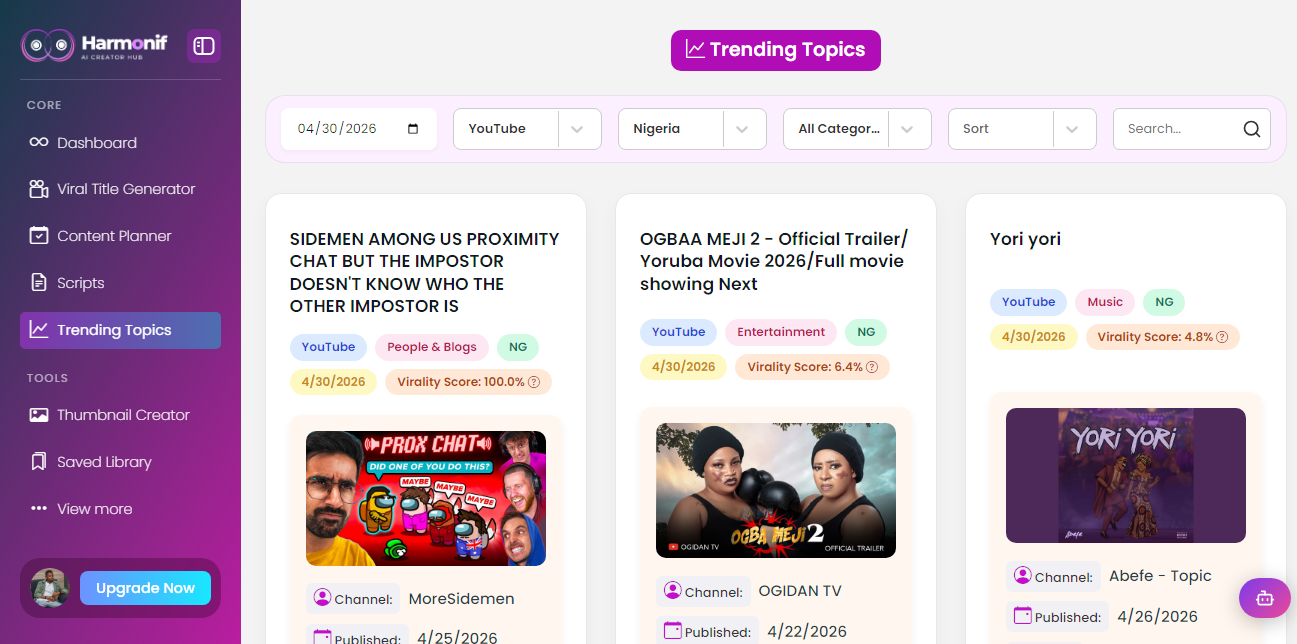
This is where Harmonif’s Trending Topics workflow is useful. Instead of starting from a blank page, you can pull emerging themes into one workspace, compare directions, and turn them into titles, scripts, and scheduled content before the window closes.
What early trend creators do differently
They do not wait for consensus. They look for repeated curiosity. They do not confuse virality with relevance. They care more about interpretive speed than reaction speed. And they turn a trend into a useful point of view fast enough that the audience associates the topic with them instead of with a random feed impression.
That is the habit to build: not just seeing a trend, but learning how to move from signal to publish while the signal is still fresh.
Common mistakes to avoid
The first mistake is treating how to find trending topics before they peak in 2026 like a one-time tactic instead of a repeatable system. Most creators get temporary results when they test a better workflow once, but they fail to turn that workflow into a habit with clear steps, deadlines, and review points.
The second mistake is optimizing for output volume before clarity. More posts, more clips, or more titles do not help if the topic fit is weak, the package is vague, or the audience payoff is unclear. Strong creator workflows usually get simpler as they improve, not noisier.
The third mistake is skipping the review loop. A creator who never checks what actually performed, what felt easy to produce, and what should be turned into a repeatable format keeps starting over. The whole point of a system is to learn faster with each publishing cycle.
What to measure after publishing
Do not judge the success of a content workflow by vanity metrics alone. The better question is whether the content attracted the right audience and created a useful next step. For some posts that means watch time and retention. For others it means saves, replies, profile visits, click-throughs, or movement toward a product or newsletter action.
You should also measure production efficiency. If a topic performs well but takes an unsustainable amount of time to create, it may need a lighter format or a better workflow. The best systems improve both content quality and execution speed over time.
- Discovery metrics: impressions, reach, search visibility, and click-through rate
- Engagement metrics: watch time, saves, comments, replies, and meaningful shares
- Conversion metrics: email signups, app clicks, feature-page visits, and product actions
- Operational metrics: time to publish, number of revisions, and backlog completion rate
Frequently asked questions
What is the best way to find trending topics for content?
The best method combines your own audience signals, adjacent creator patterns, platform trend updates, and search behavior. A topic becomes valuable when it fits your audience and still has room for a fresh angle.
How do I know if a trend is too late?
A trend is often too late when your feed is already saturated with identical takes and you cannot explain a differentiated angle. If you can only repeat what everyone else said, the window has likely narrowed.
Should every creator chase trends?
No. Creators should only chase trends that reinforce their positioning or answer existing audience demand. Relevance beats reach when the goal is long-term growth.
Referenced platform updates
This article reflects creator-platform guidance and trend signals current as of April 30, 2026.
Put this workflow into practice with Harmonif
Harmonif gives creators a faster path from idea to publish with tools for content planning, trend discovery, title generation, thumbnail ideation, script writing, and posting to socials.
Get started in the app or explore the full features overview.
A simple 7-day implementation plan
If you want to apply the ideas from How to Find Trending Topics Before They Peak in 2026 immediately, use the next seven days to turn the theory into a repeatable habit. Keep the scope narrow enough that you actually finish it, then improve it after the first cycle.
- Day 1: define the audience, topic, and outcome you want from the content
- Day 2: gather source material, examples, and recent audience questions
- Day 3: generate angles, titles, or outlines and choose the strongest direction
- Day 4: draft the main asset and map supporting content variations
- Day 5: package the asset with stronger visuals, captions, or supporting copy
- Day 6: schedule or publish the content and distribute it across the right surfaces
- Day 7: review what worked, document the lesson, and update next week’s workflow
By the end of the week, you should have more than a finished post. You should have a clearer process you can run again with less friction.
How different creators can apply this
An educational creator can use how to find trending topics before they peak in 2026 to turn expertise into a more reliable publishing engine. Instead of relying on inspiration, the creator can map recurring audience questions into clear topic clusters, build stronger weekly assets, and repurpose the best lessons into supporting posts that keep discovery active across formats.
A product-led creator or founder can use the same workflow to bridge marketing and product education. Helpful content can answer objections, demonstrate features, compare approaches, and move people toward the next logical action without every post feeling like a sales pitch. This is especially valuable when the audience needs repeated context before converting.
A service provider or consultant can use the framework to turn client knowledge into a library of trust-building assets. The same process that creates a guide, title, or trend response can also create clips, FAQs, case-study angles, and calls to action that feed discovery while reinforcing authority.
In every case, the principle is the same: the workflow should reduce friction between expertise and publication. When the system works, content quality improves because more attention can go to insight and delivery instead of scattered logistics.
A decision framework for your next publishing cycle
When deciding whether to repeat, expand, or retire a content approach, use a simple framework. First, ask whether the topic attracted the right people. Second, ask whether the format made the idea easy to consume. Third, ask whether the workflow was efficient enough to repeat without draining your team or your own energy.
If the topic fit was strong but the package was weak, improve the title, thumbnail, caption, or opening hook. If the package worked but the audience payoff was weak, strengthen the angle itself. If the content worked but the execution felt too heavy, simplify the production path and keep the idea. This keeps you from abandoning good concepts because the process around them was messy.
Creators who grow steadily tend to review performance this way. They do not just ask whether a post “did numbers.” They ask what part of the system deserves to be repeated and what part needs redesign. That mindset makes every publishing cycle more valuable.
A practical resource checklist
Before your next piece of content goes live, make sure the operational pieces around how to find trending topics before they peak in 2026 are actually prepared. Many creators lose momentum because the idea is strong but the surrounding assets are missing or inconsistent.
- A clear target audience and one-sentence content payoff
- At least three title or hook variations
- A visual plan or supporting image that reinforces the topic
- A short CTA connected to the next useful action
- A distribution plan for follow-up clips, social posts, or email reuse
- A review note for what to watch after publishing
This kind of checklist may look basic, but it removes avoidable friction. High-performing systems are rarely built on complexity. They are built on useful defaults repeated consistently.