Creators burn out when every post starts from zero. The fix is not simply “work harder” or “be more disciplined.” The fix is learning how to extract more value from a good idea. In 2026, content teams and solo creators alike are leaning harder into repurposing because the distribution environment rewards repeated, format-aware touches around the same theme.
HubSpot’s 2026 State of Marketing report calls repurposing content across channels one of the top trends of the year, but it also highlights an important nuance: the better-performing teams tailor the content to the channel instead of recycling it without adaptation. That is the whole game. Repurposing is not duplication. It is controlled transformation.
If you know how to turn one idea into thirty pieces of useful content, you stop treating consistency like a personal virtue test and start treating it like a system. Here is how that system works.
Choose an idea with enough depth
Not every idea can support thirty posts. The right source idea has emotional relevance, practical depth, and multiple sub-questions inside it. For example, “AI content planning” is strong because it contains process, tools, mistakes, examples, setup tips, and platform-specific execution. “Post every day” is much thinner unless it is tied to a broader framework.
A useful test is to ask whether the idea can produce multiple content intents. Can it become an explainer, a myth-buster, a case study, a checklist, an opinion, a story, and a tutorial? If yes, it is repurposable. If no, it may only support a short post or one-off take.
Create one pillar asset first
The easiest repurposing system begins with a pillar asset: one long-form video, webinar, tutorial, essay, podcast, or deep guide that contains the full thinking. This becomes your content mine. The rest of the month is built from extracting pieces of that mine and adapting them to different surfaces.
A pillar asset is useful because it forces your thinking to become coherent. Once the core idea is fully explained, every supporting post becomes easier. You are no longer inventing from scratch. You are choosing which fragment of the idea deserves its own spotlight.
Break the pillar into content atoms
After the pillar exists, break it into atoms: hooks, analogies, frameworks, objections, one-liners, lists, clips, screenshots, examples, mistakes, and takeaway quotes. Each atom can become a post or support a post.
This is where AI saves real time. Instead of rereading the entire source manually, you can ask an AI tool to extract distinct angles, summarize sections, rewrite one lesson for different audience stages, or convert a tutorial into social-specific prompts. The creator still edits for nuance, but the extraction work becomes much lighter.
- 1 hero video or article
- 3 to 5 shorts or clips
- 3 carousel or image-post summaries
- 5 caption-based social posts
- 3 email or newsletter angles
- 2 FAQ posts
- 2 opinion posts
- 2 myth-busting posts
- Several CTA and comment prompt variations
Match each variation to platform behavior
This is where most repurposing systems fail. The creator extracts multiple ideas but publishes them with identical formatting and tone everywhere. That ignores how audience behavior shifts from platform to platform.
A YouTube community post or image post might work best as a concise insight or teaser that leads into a deeper asset. A TikTok or Reels clip might need a stronger cold open and a more conversational pacing. An Instagram carousel might need cleaner sequence logic and visual anchoring. A LinkedIn post might need more explicit business framing. The core idea can stay the same while the delivery changes.
Think of each platform as a different doorway into the same room. You are not rebuilding the room. You are choosing the right entrance.
Use a calendar that tracks adaptation, not just dates
Repurposing becomes sustainable when your calendar tracks transformation stages. Instead of only listing publish dates, track the source asset, the derivative format, the angle, the platform, the status, and the CTA. This makes it easy to see whether your content mix is balanced or whether you are overusing one slice of the source idea.
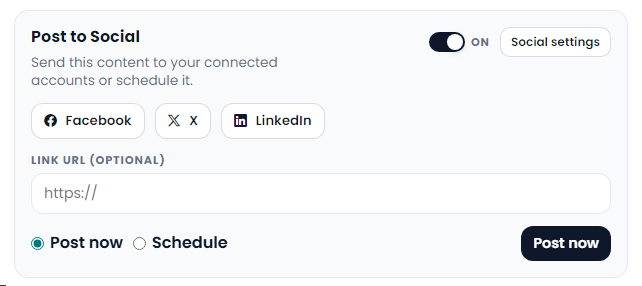
Harmonif’s Content Planner and Post to socials workflow are useful here because they turn repurposing into an operational process. You can map the source idea, attach variations, create scripts, refine titles, and publish without hopping across disconnected tools.
The hidden benefit: stronger positioning
When you repurpose correctly, your audience does not think, “Why are they talking about this again?” They think, “This creator really owns this topic.” Repetition with variation creates authority. It signals depth, not laziness.
This is one reason multi-format publishing matters more in 2026. Viewers discover across surfaces. The same person may first see a short tip, later read a carousel, then watch the full video. Every version reinforces the others. Repurposing is not just an efficiency tactic. It is a positioning tactic.
Common mistakes to avoid
The first mistake is treating how to turn one content idea into 30 posts across youtube, tiktok, and instagram like a one-time tactic instead of a repeatable system. Most creators get temporary results when they test a better workflow once, but they fail to turn that workflow into a habit with clear steps, deadlines, and review points.
The second mistake is optimizing for output volume before clarity. More posts, more clips, or more titles do not help if the topic fit is weak, the package is vague, or the audience payoff is unclear. Strong creator workflows usually get simpler as they improve, not noisier.
The third mistake is skipping the review loop. A creator who never checks what actually performed, what felt easy to produce, and what should be turned into a repeatable format keeps starting over. The whole point of a system is to learn faster with each publishing cycle.
What to measure after publishing
Do not judge the success of a content workflow by vanity metrics alone. The better question is whether the content attracted the right audience and created a useful next step. For some posts that means watch time and retention. For others it means saves, replies, profile visits, click-throughs, or movement toward a product or newsletter action.
You should also measure production efficiency. If a topic performs well but takes an unsustainable amount of time to create, it may need a lighter format or a better workflow. The best systems improve both content quality and execution speed over time.
- Discovery metrics: impressions, reach, search visibility, and click-through rate
- Engagement metrics: watch time, saves, comments, replies, and meaningful shares
- Conversion metrics: email signups, app clicks, feature-page visits, and product actions
- Operational metrics: time to publish, number of revisions, and backlog completion rate
Frequently asked questions
What does repurposing content mean?
Repurposing content means taking one core idea or source asset and adapting it into multiple formats, platforms, and audience entry points without simply copy-pasting the same post everywhere.
How many posts can one content idea create?
A strong pillar idea can often generate 15 to 30 usable assets once it is broken into hooks, clips, quotes, carousels, FAQs, and platform-specific derivatives.
Should I post the same caption on every platform?
No. Reuse the idea, not the exact formatting. Platform-specific behavior matters, and adapted captions usually perform better than identical reposts.
Referenced platform updates
This article reflects creator-platform guidance and trend signals current as of April 30, 2026.
Put this workflow into practice with Harmonif
Harmonif gives creators a faster path from idea to publish with tools for content planning, trend discovery, title generation, thumbnail ideation, script writing, and posting to socials.
Get started in the app or explore the full features overview.
A simple 7-day implementation plan
If you want to apply the ideas from How to Turn One Content Idea Into 30 Posts Across YouTube, TikTok, and Instagram immediately, use the next seven days to turn the theory into a repeatable habit. Keep the scope narrow enough that you actually finish it, then improve it after the first cycle.
- Day 1: define the audience, topic, and outcome you want from the content
- Day 2: gather source material, examples, and recent audience questions
- Day 3: generate angles, titles, or outlines and choose the strongest direction
- Day 4: draft the main asset and map supporting content variations
- Day 5: package the asset with stronger visuals, captions, or supporting copy
- Day 6: schedule or publish the content and distribute it across the right surfaces
- Day 7: review what worked, document the lesson, and update next week’s workflow
By the end of the week, you should have more than a finished post. You should have a clearer process you can run again with less friction.
How different creators can apply this
An educational creator can use how to turn one content idea into 30 posts across youtube, tiktok, and instagram to turn expertise into a more reliable publishing engine. Instead of relying on inspiration, the creator can map recurring audience questions into clear topic clusters, build stronger weekly assets, and repurpose the best lessons into supporting posts that keep discovery active across formats.
A product-led creator or founder can use the same workflow to bridge marketing and product education. Helpful content can answer objections, demonstrate features, compare approaches, and move people toward the next logical action without every post feeling like a sales pitch. This is especially valuable when the audience needs repeated context before converting.
A service provider or consultant can use the framework to turn client knowledge into a library of trust-building assets. The same process that creates a guide, title, or trend response can also create clips, FAQs, case-study angles, and calls to action that feed discovery while reinforcing authority.
In every case, the principle is the same: the workflow should reduce friction between expertise and publication. When the system works, content quality improves because more attention can go to insight and delivery instead of scattered logistics.
A decision framework for your next publishing cycle
When deciding whether to repeat, expand, or retire a content approach, use a simple framework. First, ask whether the topic attracted the right people. Second, ask whether the format made the idea easy to consume. Third, ask whether the workflow was efficient enough to repeat without draining your team or your own energy.
If the topic fit was strong but the package was weak, improve the title, thumbnail, caption, or opening hook. If the package worked but the audience payoff was weak, strengthen the angle itself. If the content worked but the execution felt too heavy, simplify the production path and keep the idea. This keeps you from abandoning good concepts because the process around them was messy.
Creators who grow steadily tend to review performance this way. They do not just ask whether a post “did numbers.” They ask what part of the system deserves to be repeated and what part needs redesign. That mindset makes every publishing cycle more valuable.
A practical resource checklist
Before your next piece of content goes live, make sure the operational pieces around how to turn one content idea into 30 posts across youtube, tiktok, and instagram are actually prepared. Many creators lose momentum because the idea is strong but the surrounding assets are missing or inconsistent.
- A clear target audience and one-sentence content payoff
- At least three title or hook variations
- A visual plan or supporting image that reinforces the topic
- A short CTA connected to the next useful action
- A distribution plan for follow-up clips, social posts, or email reuse
- A review note for what to watch after publishing
This kind of checklist may look basic, but it removes avoidable friction. High-performing systems are rarely built on complexity. They are built on useful defaults repeated consistently.
How to keep the content aligned with your audience
The fastest way to waste a good workflow is to apply it to topics your audience does not actually care about. Before publishing, check whether the idea is tied to a real question, frustration, aspiration, or decision your audience already has. Relevance creates far more growth than empty volume.
One practical approach is to compare your draft against recent comments, DMs, support questions, customer calls, or search terms. If the language in the content feels disconnected from the language your audience uses naturally, refine the framing. Even a strong post will underperform if the audience cannot immediately recognize that it is for them.
This is also where category fit matters. A creator who talks to beginners should package the topic differently from a creator speaking to advanced operators. The workflow may stay the same, but the examples, pacing, and assumptions should match the person you want to help.
How to reuse the best results
Once a post performs well, the job is not finished. Strong creator systems reuse wins deliberately. A successful article can become a script. A successful script can become a Short. A strong social post can become an FAQ, a feature-page support section, or a newsletter issue. This is how one useful insight turns into a full content asset stack.
Reusing results also improves SEO and discoverability because it creates more connected assets around the same intent. Instead of producing ten disconnected topics, you build a cluster of related content that reinforces your authority and gives the audience multiple ways to enter the conversation.
The real question after every successful post is simple: what is the next logical version of this idea? Creators who answer that consistently build stronger libraries, not just isolated wins.